
Denial of Service Attack

DoS & DDoS Attack Hacker's Guide
What is DoS & DDoS Attacks?
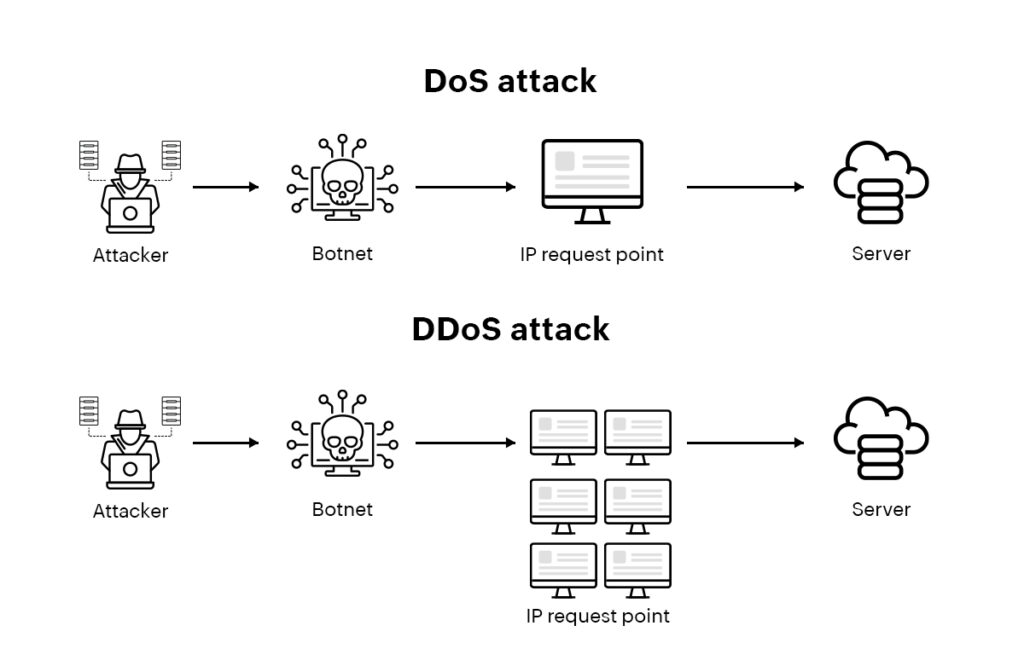
What is a DOS denial-of-service attack?
A denial-of-service (DoS) attack is a type of cyber attack in which a malicious actor aims to render a computer or other device unavailable to its intended users by interrupting the device’s normal functioning. DoS attacks typically function by overwhelming or flooding a targeted machine with requests until normal traffic is unable to be processed, resulting in denial-of-service to addition users. A DoS attack is characterized by using a single computer to launch the attack.
What is DDoS Distributed Denial of Service Attack ?
A distributed denial-of-service attack is a type of DoS attack that comes from many distributed sources, such as a
What are the Types of DDoS Attacks
There are various types of DDoS attacks mentioned below:
- Volumetric Attacks: Volumetric Attacks are the most prevalent form of DDoS attacks. They use a botnet to overload the network or server with heavy traffic but exceed the network’s capabilities of processing the traffic. This attack overloads the target with huge amounts of junk data. This leads to the loss of network bandwidth and can lead to a complete denial of service.
- Protocol Attacks: TCP Connection Attacks exploit a vulnerability in the TCP connection sequence which is commonly referred to as the three-way handshake connection between the host and the server. The work is explained as follows. The targeted server receives a request to start with the handshake. In this attack, the handshake is never accomplished. This leaves the connected port as busy and unavailable to process any further requests. Meanwhile, the cybercriminal continues to send multiple requests overwhelming all the working ports and shutting down the server.
- Application Attacks: Application layer attacks (Layer 7 attacks) target the applications of the victim in a slower fashion. Thus, they may initially appear as legitimate requests from users and the victim becomes unable to respond. These attacks target the layer where a server generates web pages and responds to HTTP requests. Application-level attacks are combined with other kinds of DDoS attacks targeting applications, along with the network and bandwidth. These attacks are threatening as it is more difficult for companies to detect.
- Fragmentation Attacks: The cybercriminal exploits frangibility in the datagram fragmentation process, in which IP datagrams are divided into smaller packets, transferred across a network, and then reassembled. In such attacks, fake data packets are unable to be reassembled.
How do DDoS Attacks Work?
The primary focus of a DoS attack is to oversaturate the capacity of a targeted machine, resulting in denial-of-service to additional requests. The multiple attack vectors of DoS attacks can be grouped by their similarities.
DoS attacks follow under these categories:
Buffer Overflow Attack
Flood Attack
An attack type in which a memory buffer Overflow can cause a machine to consume all available hard disk space, memory, or CPU time.
By saturating a targeted server with an overwhelming amount of packets, a malicious actor is able to oversaturate server capacity